Industries
You are here: Home » Industries

Industries

  • EPDM Granule Flooring: Thickness Classification & Practical Application Guide
    EPDM (Ethylene Propylene Diene Monomer) granule flooring is made by mixing colored EPDM particles with PU adhesive and constructing seamless on-site, featuring anti-UV, slip-resistant, elastic and colorful advantages, widely applied in playgrounds, gymnasiums, sports courts, park walkways and aquatic surroundings. Floor thickness directly determines shock absorption, fall protection, noise reduction, wear resistance and project cost. This article classifies mainstream EPDM thickness specifications from 5mm to 50mm, matches corresponding application scenarios based on international safety standards EN1177 and ASTM F1292, and analyzes performance differences of varied thickness to provide scientific reference for venue design and material selection. Read More
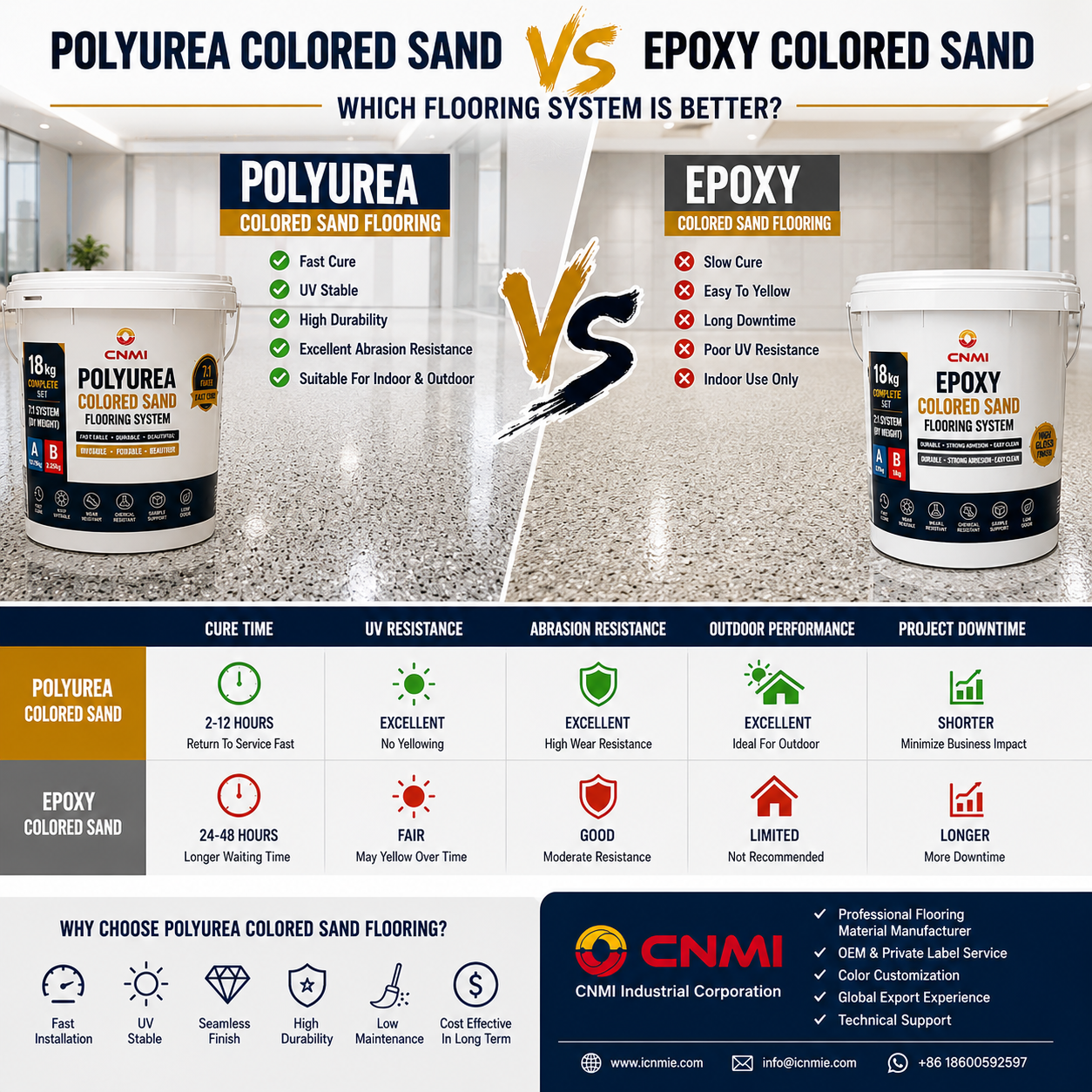
  • Polyurea Colored Sand vs Epoxy Colored Sand: Which Flooring System Is Better?
    Polyurea Colored Sand Flooring and Epoxy Colored Sand Flooring are two popular decorative flooring systems. While epoxy offers a cost-effective indoor solution, polyurea provides faster curing, superior UV resistance, enhanced durability, and shorter project downtime. This article compares both technologies to help contractors, distributors, and project owners select the best flooring system for commercial and industrial renovation projects. Read More
  • Gym Rubber Flooring: Thickness, Material and Performance Guide
    Rubber flooring has become the standard surface for both commercial and home gyms due to its outstanding durability, safety, and acoustic performance. The thickness and material type directly influence shock absorption, noise isolation, slip resistance, and service life. This article provides a practical guide to selecting gym rubber flooring based on thickness, material composition, and application scenarios, helping gym owners and users make cost-effective and high-performance flooring decisions. Read More
  • Gym Rubber Flooring: Thickness Guide and Key Applications Keywords
    Rubber flooring has become the standard choice for both home and commercial gyms due to its durability, safety, and versatility. The thickness of rubber mats directly impacts shock absorption, noise reduction, slip resistance, and overall performance. Selecting the right thickness ensures effective protection for floors, equipment, and athletes while optimizing workout comfort. This article explains common thickness specifications, their functional differences, and ideal applications for each, helping gym owners and users make informed flooring decisions. Read More
  • Factors Affecting Adhesive Mixing Ratio for Rubber Mats
    The adhesive mixing ratio directly decides the bonding effect, structural performance and service life of rubber mats. A reasonable ratio must be formulated by combining multiple influencing factors. This article sorts out the main factors that affect the matching proportion between rubber granules and adhesive, including raw material characteristics, on-site construction conditions, application scenarios and technical requirements. It analyzes the influence mechanism of each factor, and provides reference for scientific batching and standardized construction in actual production and laying. Read More
  • Proportioning on Molding Quality and Long-Term Service Performance of Rubber Flooring Mats
    Rubber flooring mats are widely utilized in recreational, commercial and industrial flooring systems for their superior safety, elasticity and environmental adaptability. Adhesive proportioning is a critical manufacturing and construction parameter that governs the interfacial bonding state between rubber granules and directly determines the molding quality and long-term service performance of finished mats. Different from macroscopic structural failure caused by extreme proportion deviation, subtle mismatches in adhesive proportion can induce latent defects such as inconsistent molding shrinkage, poor interfacial adhesion and attenuated weather resistance, which gradually degrade the overall performance of rubber mats in long-term service. Read More
  • Thickness Classification and Practical Applications of Gym Rubber Flooring Mats
    Rubber flooring mats are essential functional facilities for home and commercial gyms, whose thickness directly determines shock absorption, anti-slip performance, noise reduction effect and service scenarios. Selecting a reasonable mat thickness is critical to protecting building floors, reducing sports injuries, lowering exercise noise, and improving the overall service life of fitness equipment. This paper systematically classifies common thickness specifications of gym rubber mats, analyzes the functional advantages of mats with different thicknesses, and matches them with corresponding fitness scenarios including light aerobic exercise, functional training, heavy weightlifting and group fitness. Read More
  • The Influence of Adhesive Mixing Ratio on the Performance and Durability of Rubber Mats
    Rubber mats are widely applied in sports venues, public facilities, industrial sites and residential spaces due to their excellent shock absorption, anti-slip and wear-resistant properties. The adhesive mixing ratio is one of the core technical parameters that determine the overall performance of rubber mats, directly affecting the bonding strength, structural stability, mechanical properties and service life of finished products. Unreasonable proportioning of rubber particles and adhesive will cause a series of quality defects, including particle shedding, surface hardening, poor flexibility and shortened service cycle. This paper systematically analyzes the influence mechanism of adhesive mixing ratio on the key performance of rubber mats, discusses the quality problems caused by excessive or insufficient adhesive dosage, and summarizes the optimal proportioning principles and construction control points. Read More
  • Selection of EPDM Colored Granules Weight Composition Based on Different Application Scenarios
    EPDM (Ethylene Propylene Diene Monomer) colored granules are widely applied in sports venues, children’s playgrounds, municipal walkways and commercial flooring due to their excellent elasticity, weather resistance, anti-aging performance and environmental friendliness. The weight composition of EPDM granules, including EPDM rubber matrix, inorganic fillers, plasticizers, color pigments, vulcanizing systems and functional additives, is the core factor that determines the mechanical properties, color fastness, service life and comprehensive cost of finished products. Improper component weight ratio matching will lead to common defects such as insufficient elasticity, easy fading, brittle cracking and poor wear resistance. Read More
  • Total 17 pages  Go to Page
  • Go
CNMI Industrial Corp is an industry leader in epoxy resin and pigment manufacturing.
We have been serving the Resin art DIY,Epoxy floor,Carbon &fiber compisite.

Quick Links

Products

Policy

Contact us
 Copyright © 2024 CNMI Industrial Corporation. All rights reserved. Sitemap Support by leadong.com Privacy Policy